
2.4. Linear Bivariate BMM with calibration of Coleman toy models.#
The best way to learn Taweret is to use it. You can run, modify and experiment with this notebook on GitHub Codespaces.
The models can be found in Coleman Thesis : https://go.exlibris.link/3fVZCfhl
This notebook shows how to use the Bayesian model mixing package Taweret for a toy problem.
Author : Dan Liyanage
Date : 11/13/2022
import sys
import os
# You will have to change the following imports depending on where you have
# the packages installed

# ! pip install Taweret    # if using Colab, uncomment to install

cwd = os.getcwd()

# Get the first part of this path and append to the sys.path
tw_path = cwd.split("Taweret/")[0] + "Taweret"
sys.path.append(tw_path)

# For plotting
import matplotlib.pyplot as plt

! pip install seaborn    # comment if installed
! pip install ptemcee    # comment if installed

import seaborn as sns
sns.set_context('poster')
# To define priors. (uncomment if not using default priors)
# ! pip install bilby     # uncomment this line if bilby is not already installed
# import bilby

# For other operations
import numpy as np
Requirement already satisfied: seaborn in /home/runner/work/Taweret/Taweret/.tox/book/lib/python3.13/site-packages (0.13.2)
Requirement already satisfied: numpy!=1.24.0,>=1.20 in /home/runner/work/Taweret/Taweret/.tox/book/lib/python3.13/site-packages (from seaborn) (2.5.3)
Requirement already satisfied: pandas>=1.2 in /home/runner/work/Taweret/Taweret/.tox/book/lib/python3.13/site-packages (from seaborn) (3.0.6)
Requirement already satisfied: matplotlib!=3.6.1,>=3.4 in /home/runner/work/Taweret/Taweret/.tox/book/lib/python3.13/site-packages (from seaborn) (3.11.2)
Requirement already satisfied: contourpy>=1.0.1 in /home/runner/work/Taweret/Taweret/.tox/book/lib/python3.13/site-packages (from matplotlib!=3.6.1,>=3.4->seaborn) (1.4.0)
Requirement already satisfied: cycler>=0.10 in /home/runner/work/Taweret/Taweret/.tox/book/lib/python3.13/site-packages (from matplotlib!=3.6.1,>=3.4->seaborn) (0.12.1)
Requirement already satisfied: fonttools>=4.28.2 in /home/runner/work/Taweret/Taweret/.tox/book/lib/python3.13/site-packages (from matplotlib!=3.6.1,>=3.4->seaborn) (4.66.1)
Requirement already satisfied: kiwisolver>=1.3.1 in /home/runner/work/Taweret/Taweret/.tox/book/lib/python3.13/site-packages (from matplotlib!=3.6.1,>=3.4->seaborn) (1.5.1)
Requirement already satisfied: packaging>=20.0 in /home/runner/work/Taweret/Taweret/.tox/book/lib/python3.13/site-packages (from matplotlib!=3.6.1,>=3.4->seaborn) (26.3)
Requirement already satisfied: pillow>=9 in /home/runner/work/Taweret/Taweret/.tox/book/lib/python3.13/site-packages (from matplotlib!=3.6.1,>=3.4->seaborn) (12.3.0)
Requirement already satisfied: pyparsing>=3 in /home/runner/work/Taweret/Taweret/.tox/book/lib/python3.13/site-packages (from matplotlib!=3.6.1,>=3.4->seaborn) (3.3.3)
Requirement already satisfied: python-dateutil>=2.7 in /home/runner/work/Taweret/Taweret/.tox/book/lib/python3.13/site-packages (from matplotlib!=3.6.1,>=3.4->seaborn) (2.9.0.post0)
Requirement already satisfied: six>=1.5 in /home/runner/work/Taweret/Taweret/.tox/book/lib/python3.13/site-packages (from python-dateutil>=2.7->matplotlib!=3.6.1,>=3.4->seaborn) (1.17.0)
Requirement already satisfied: ptemcee in /home/runner/work/Taweret/Taweret/.tox/book/lib/python3.13/site-packages (1.0.0)
Requirement already satisfied: numpy in /home/runner/work/Taweret/Taweret/.tox/book/lib/python3.13/site-packages (from ptemcee) (2.5.3)
# Import models with a predict method
from Taweret.models import coleman_models as toy_models

m1 = toy_models.coleman_model_1()
m2 = toy_models.coleman_model_2()
truth = toy_models.coleman_truth()
g = np.linspace(-1,9,10)
plot_g = np.linspace(-1,9,100)
true_output = truth.evaluate(plot_g)
exp_data = truth.evaluate(g)
2.4.1. 1. The models and the experimental data.#
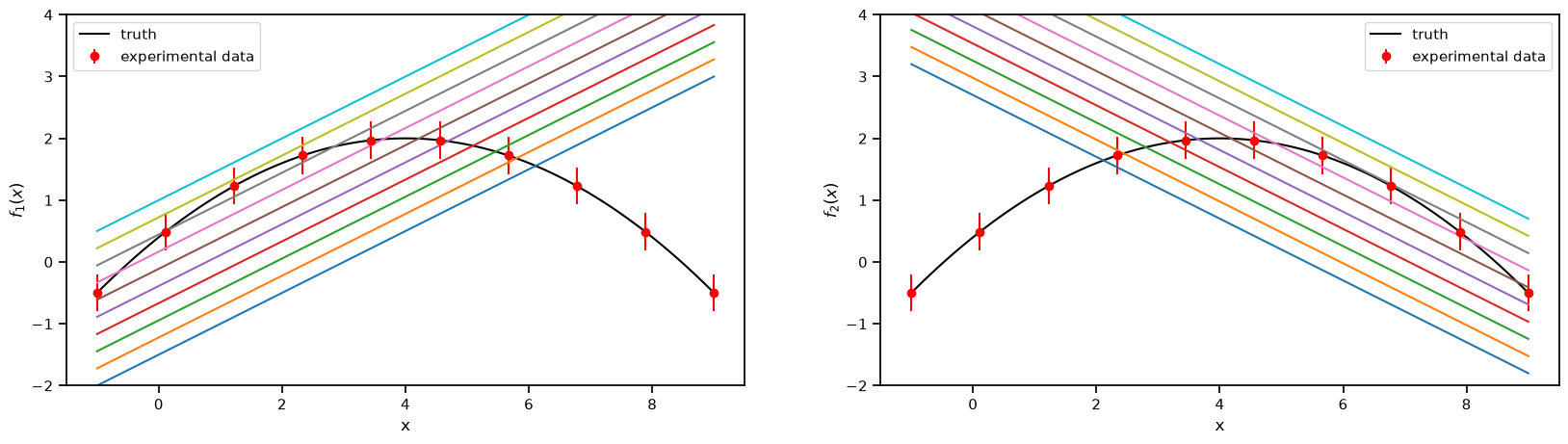
Truth
\(f(x) = 2-0.1(x-4)^2\), where \(x \in [-1, 9]\)
Model 1
\(f_1(x,\theta)= 0.5(x+\theta)-2\) , where \(\theta \in [1, 6]\)
Model 2
\(f_2(x,\theta)= -0.5(x-\theta) + 3.7\) , where \(\theta \in [-2, 3]\)
Experimental data
sampled from the Truth with a fixed standard deviation of 0.3
sns.set_context('notebook')
fig, axs = plt.subplots(1,2,figsize=(20,5))
prior_ranges = [(1,6), (-2,3)]
for i in range(0,2):
    ax = axs.flatten()[i]
    ax.plot(plot_g, true_output[0], label='truth', color='black')
    ax.errorbar(g,exp_data[0],exp_data[1], fmt='o', label='experimental data', color='r')
    ax.legend()
    ax.set_ylim(-2,4)
    for value in np.linspace(*prior_ranges[i],10):
        if i==0:
            predict_1 = m1.evaluate(plot_g, value)
            ax.plot(plot_g, predict_1[0])
            ax.set_ylabel(r'$f_1(x)$')
        if i==1:
            predict_2 = m2.evaluate(plot_g, value)
            ax.plot(plot_g, predict_2[0])
            ax.set_ylabel(r'$f_2(x)$')
    ax.set_xlabel('x')
2.4.2. 2. Choose a Mixing method#
# Mixing method
from Taweret.mix.bivariate_linear import BivariateLinear as BL

models= {'model1':m1,'model2':m2}
mix_model = BL(models_dic=models, method='cdf', nargs_model_dic={'model1':1, 'model2':1})
## uncomment to change the prior from the default
import bilby

priors = bilby.core.prior.PriorDict()
priors['cdf_0'] = bilby.core.prior.Normal(0, 1, name="cdf_0")
priors['cdf_1'] = bilby.core.prior.Normal(0, 1, name="cdf_1")
mix_model.set_prior(priors)
{'cdf_0': Normal(mu=0, sigma=1, name='cdf_0', latex_label='cdf_0', unit=None, boundary=None),
 'cdf_1': Normal(mu=0, sigma=1, name='cdf_1', latex_label='cdf_1', unit=None, boundary=None),
 'model1_0': Uniform(minimum=1, maximum=6, name='model1_0', latex_label='model1_0', unit=None, boundary=None),
 'model2_0': Uniform(minimum=-2, maximum=3, name='model2_0', latex_label='model2_0', unit=None, boundary=None)}
mix_model.prior
{'cdf_0': Normal(mu=0, sigma=1, name='cdf_0', latex_label='cdf_0', unit=None, boundary=None),
 'cdf_1': Normal(mu=0, sigma=1, name='cdf_1', latex_label='cdf_1', unit=None, boundary=None),
 'model1_0': Uniform(minimum=1, maximum=6, name='model1_0', latex_label='model1_0', unit=None, boundary=None),
 'model2_0': Uniform(minimum=-2, maximum=3, name='model2_0', latex_label='model2_0', unit=None, boundary=None)}
2.4.3. 3. Train to find posterior#
kwargs_for_sampler = {'sampler': 'ptemcee',
                    'ntemps': 5,
                    'nwalkers': 50,
                    'Tmax': 100,
                    'burn_in_fixed_discard': 50,
                    'nsamples': 2000,
                    'threads': 6,
                    'verbose': False}

result = mix_model.train(x_exp=g, y_exp=exp_data[0], y_err=exp_data[1],
                        label='cdf_mix',
                        outdir='outdir/coleman',
                        kwargs_for_sampler=kwargs_for_sampler,
                        load_previous=False)
/home/runner/work/Taweret/Taweret/.tox/book/lib/python3.13/site-packages/bilby/core/likelihood.py:127: FutureWarning: Setting non-trivial parameters for <class 'Taweret.sampler.likelihood_wrappers.likelihood_wrapper_for_bilby'>. This is deprecated behaviour  and will be removed in Bilby version 3. See https://bilby-dev.github.io/bilby/parameters for more details.
  warnings.warn(msg, FutureWarning)
19:04 bilby INFO    : Running for label 'cdf_mix', output will be saved to 'outdir/coleman'
/home/runner/work/Taweret/Taweret/.tox/book/lib/python3.13/site-packages/bilby/core/sampler/ptemcee.py:134: FutureWarning: The ptemcee sampler interface in bilby is deprecated and will be removed in Bilby version 3. Please use the `ptemcee-bilby`sampler plugin instead: https://github.com/bilby-dev/ptemcee-bilby.
  warnings.warn(msg, FutureWarning)
19:04 bilby INFO    : Analysis priors:
19:04 bilby INFO : cdf_0=Normal(mu=0, sigma=1, name='cdf_0', latex_label='cdf_0', unit=None, boundary=None)
19:04 bilby INFO : cdf_1=Normal(mu=0, sigma=1, name='cdf_1', latex_label='cdf_1', unit=None, boundary=None)
19:04 bilby INFO : model1_0=Uniform(minimum=1, maximum=6, name='model1_0', latex_label='model1_0', unit=None, boundary=None)
19:04 bilby INFO : model2_0=Uniform(minimum=-2, maximum=3, name='model2_0', latex_label='model2_0', unit=None, boundary=None)
19:04 bilby INFO : Analysis likelihood class: <class 'Taweret.sampler.likelihood_wrappers.likelihood_wrapper_for_bilby'>
19:04 bilby INFO : Analysis likelihood noise evidence: nan
19:04 bilby INFO : Single likelihood evaluation took 2.795e-04 s
19:04 bilby INFO : Using sampler Ptemcee with kwargs {'ntemps': 5, 'nwalkers': 50, 'Tmax': 100, 'betas': None, 'a': 2.0, 'adaptation_lag': 10000, 'adaptation_time': 100, 'random': None, 'adapt': False, 'swap_ratios': False}
19:04 bilby INFO : Global meta data was removed from the result object for compatibility. Use the `BILBY_INCLUDE_GLOBAL_METADATA` environment variable to include it. This behaviour will be removed in a future release. For more details see: https://bilby-dev.github.io/bilby/faq.html#global-meta-data
19:04 bilby INFO : Using convergence inputs: ConvergenceInputs(autocorr_c=5, autocorr_tol=50, autocorr_tau=1, gradient_tau=0.1, gradient_mean_log_posterior=0.1, Q_tol=1.02, safety=1, burn_in_nact=50, burn_in_fixed_discard=50, mean_logl_frac=0.01, thin_by_nact=0.5, nsamples=2000, ignore_keys_for_tau=None, min_tau=1, niterations_per_check=5)
19:04 bilby INFO : Generating pos0 samples
19:04 bilby INFO : Starting to sample
19:05 bilby INFO : Finished sampling
19:05 bilby INFO : Writing checkpoint and diagnostics
19:05 bilby INFO : Finished writing checkpoint
19:05 bilby INFO : Sampling time: 0:00:44.165299
19:05 bilby WARNING : Result.save_to_file called with extension=True. This will default to json, and ignore the extension from the filename. This behaviour is deprecated and will be removed.
19:05 bilby WARNING : Result.save_to_file called with extension=True. This will default to json, and ignore the extension from the filename. This behaviour is deprecated and will be removed.
19:05 bilby INFO    : Summary of results:
nsamples: 2700
ln_noise_evidence:    nan
ln_evidence: -10.479 +/-  2.552
ln_bayes_factor:    nan +/-  2.552
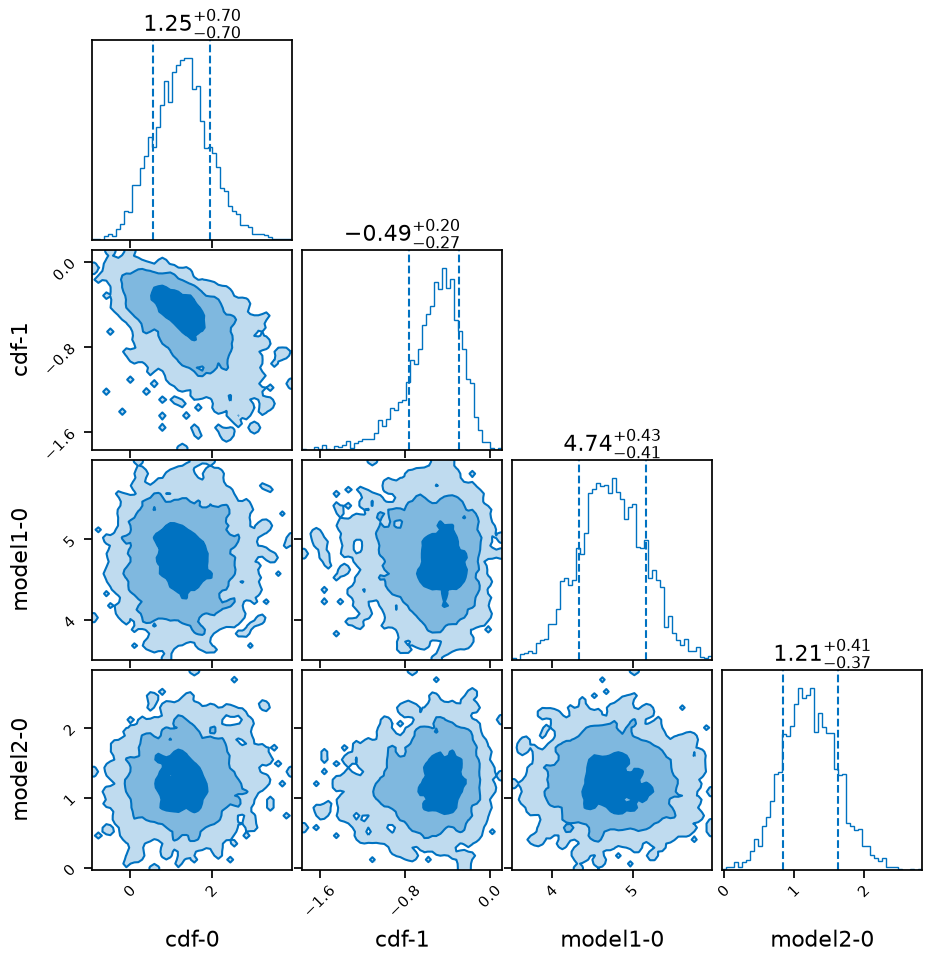
result.plot_corner()
2.4.3.1. 4. Predictions#
_,mean_prior,CI_prior, _ = mix_model.prior_predict(plot_g, CI=[5,20,80,95])
_,mean,CI, _ = mix_model.predict(plot_g, CI=[5,20,80,95])
per5, per20, per80, per95 = CI
prior5, prior20, prior80, prior95 = CI_prior
mix_model.map
array([ 3.15899647, -0.94929039, 4.67387993, 1.14895013])
# Map value prediction for the step mixing function parameter
model_params = [np.array(mix_model.map[2]), np.array(mix_model.map[3])]
map_prediction = mix_model.evaluate(mix_model.map[0:2], plot_g, model_params=model_params)
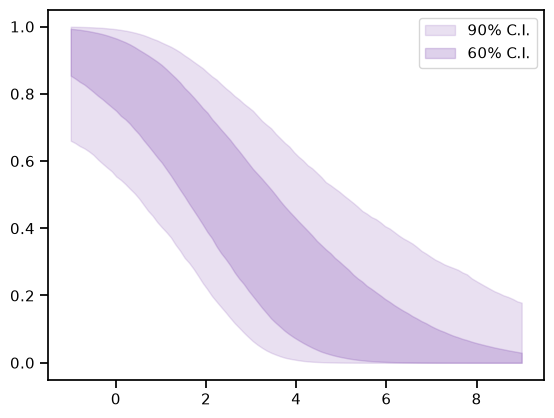
_,_,CI_weights,_=mix_model.predict_weights(plot_g, CI=[5,20, 80, 95])
perw_5, perw_20, perw_80, perw_95 = CI_weights
%matplotlib inline
fig, ax = plt.subplots()
ax.fill_between(plot_g,perw_5,perw_95,color=sns.color_palette()[4], alpha=0.2, label='90% C.I.')
ax.fill_between(plot_g,perw_20,perw_80, color=sns.color_palette()[4], alpha=0.3, label='60% C.I.')
ax.legend()
#ax.plot(plot_g, true_output[0], label='truth')
#ax.set_ylim(1.2,3.2)
<matplotlib.legend.Legend at 0x7f8eef1679d0>
%matplotlib inline
sns.set_context('poster')
fig, ax = plt.subplots(figsize=(10,10))
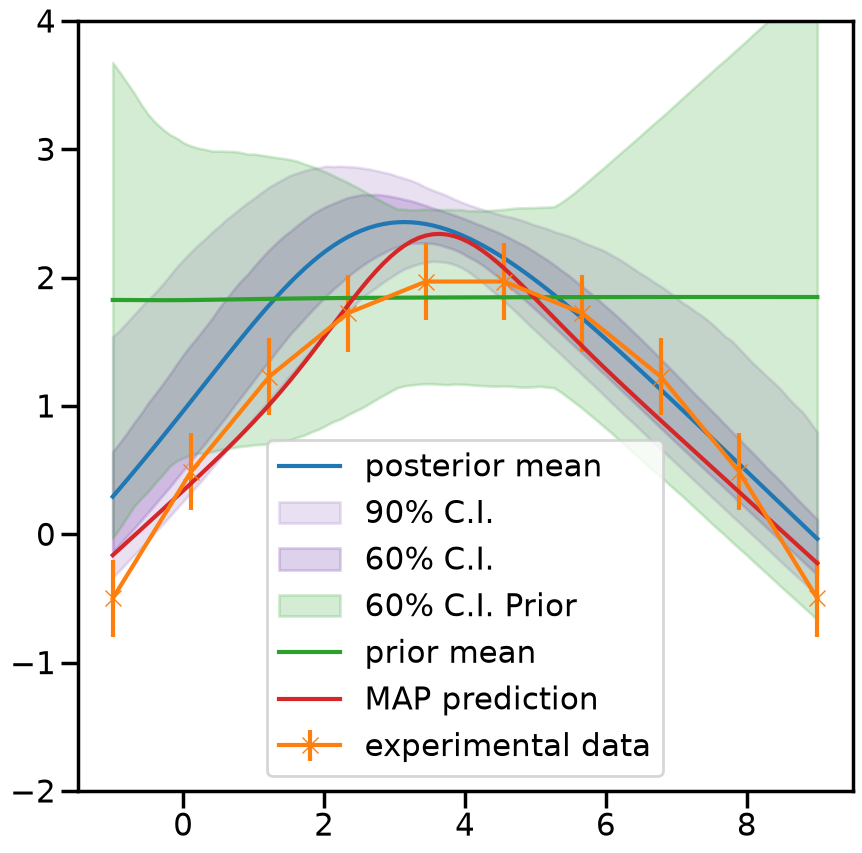
ax.plot(plot_g, mean.flatten(), label='posterior mean')
ax.fill_between(plot_g,per5.flatten(),per95.flatten(),color=sns.color_palette()[4], alpha=0.2, label='90% C.I.')
ax.fill_between(plot_g,per20.flatten(),per80.flatten(), color=sns.color_palette()[4], alpha=0.3, label='60% C.I.')
ax.fill_between(plot_g,prior20.flatten(),prior80.flatten(),color=sns.color_palette()[2], alpha=0.2, label='60% C.I. Prior')
ax.errorbar(g,exp_data[0],yerr=exp_data[1], marker='x', label='experimental data')
ax.plot(plot_g, mean_prior.flatten(), label='prior mean')
ax.plot(plot_g, map_prediction.flatten(), label='MAP prediction')
ax.set_ybound(-2,4)
ax.legend()
<matplotlib.legend.Legend at 0x7f8eefc12fd0>